Category Archives: Uncategorized

The Tragedy of Dog Training

fearfuldogs's avatarFearfuldogs' Blog

It is not difficult to make a name for one’s self in this industry, and I say that speaking from experience. Come up with an idea or rehash an old one, package it well and people will buy it. It’s not always a bad thing. I like to think that my focus on the sciences of learning and animal behavior for coming up with solutions to help our fearful dogs is among the good things.

Recently on a social media site someone selling a product, which may be a great addition to the industry, described themselves as a “professional holistic dog trainer.” I asked what that meant and received this reply:

“Professional Holistic Dog Trainer means that I take a look at the dog from the physical, emotional, psychological and spiritual aspects of the dog. I have a very detailed background in bodywork and dog biomechanics so I only do training…

View original post 740 more words

“It’s all in how they’re raised.”

as recently stated at the SPARCS 2014 conference, behavior is 100% genetics and 100% environment – you cannot unpick the two

Paws Abilities Dog Training's avatarPaws Abilities

“All puppies are blank slates.” “If you do everything right with your puppy, you’ll have a great adult dog.” “If dogs have behavioral issues, we should blame the handle end of the leash.”

These are common misconceptions I hear as a trainer, and they make me so very sad. Behavior is a combination of nature and nurture, and if we could just take a moment to look logically at these myths, we would see just how silly they are.

Photo by Tavallai Photo by Tavallai

Genetics influence behavior. This is part of the reason we have breeds: if you want a dog to work your sheep, you’re going to choose a Border Collie, not a Brittany Spaniel. Even though the two dogs have the same basic size and shape, one is more likely to have the instinctive motor patterns to do the work than the other. Getting a Border Collie whose parents…

View original post 978 more words

Do Some Dogs Need a Heavier Hand?

What if your dog is HUGE and you have trouble controlling him? Is it easier to teach him what you would like him to do, or manhandle him?

wildewmn's avatarWilde About Dogs

It never fails—someone always says it. In an recent online discussion about a trainer known for using less-than-gentle methods, someone made a comment that sounded a lot like this: “Positive training is fine for smaller dogs and puppies, and maybe even some adults, but there are some dogs that need a heavier hand.” Really? Because that sounds an awful lot like justification for jerking, yanking, shocking, and other things done to dogs in the name of training.

I’ve heard the excuse for heavy-handedness put like this: “They’re red zone dogs” (somehow that term always makes me visualize dogs with red, flashing sirens over their heads) or something similar. The term is meant to indicate dogs who are severely aggressive, and often the trainer has been brought in as last-ditch effort before the dog is euthanized. In my years of working in canine training and behavior, I’ve worked with many of…

View original post 605 more words

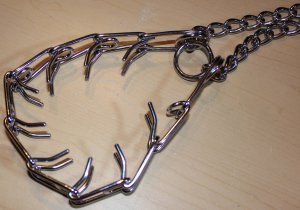
Pinch Me A.K.A. Prong Me

I always try to steer people away from prong and choke collars. Heck, I don’t even like to see martingales, or standard collars high up on the neck.

awesomedogs's avatarawesomedogs

During a recent Facebook discussion, it was pointed out that I had never worn a prong collar.  As such, I would  have no idea whether a prong (a.k.a. pinch collar) causes pain.  My knuckles firmly rapped, it seemed the only solution would be for me to open my mind and wear a prong collar.

prongFor those unfamiliar with the product, these come in a variety of styles.  Some look scary with spikes and “prongs” of metal.  Newer models hide the “teeth” of the prong collar under a strip of leather, plastic or fabric.  I use the word “teeth” very deliberately, because proponents of these products claim that the spikes of a prong replicate a mother dog’s teeth as she corrects a misbehaving pup.

I do know how to fit a prong collar, and I know how to use one.  I am a crossover trainer, meaning that I have used physical…

View original post 830 more words

Was It Out of Spite? Think Again.

so give them something to do…hidden treats to find, frozen kong to lick.

Conscious Companion®'s avatarConscious Companion®

Many animal guardians truly believe that their cat, dog, bird, rabbit, pig, horse etc. does things “to them” out of spite or malice.  New Flash: This is not true.  When we don’t know how or why an animal behavior problem exists, we tend to make it about us; we personalize it.  In the animal behavior world, this is referred to this as Anthropomorphism.

Anthropomorphism: Attributing human motivation, characteristics, or behavior to inanimate objects, animals, or natural phenomena


8 Things We Must Acknowledge:

1. All Behavior Serves a Purpose.

Every behavior that at animal does serves a purpose to fit that animal’s particular need at the time; that purpose is not to upset us.  When we find urine or feces on purses, backpacks, clothing, bedding, etc. most people’s first thought is usually that the cat or dog is doing it because he or she is mad or spiteful.  Nothing could…

View original post 2,307 more words

“Hey, have you heard the one about climate change and dog training?”

This is exactly what I would have said, if I had thought to write it first (minus the astrophysicist stuff)! Positive reinforcement is the most effective way to train you dog. Period.

emily douglas's avatarThe Unexamined Dog

So a man walks into a bar and sees a dog sitting at the counter.  He turns to the dog and asks, “So what do you think about all the controversy surrounding the best methods and tools for training dogs?”

The dog takes a sip of his beer, briefly licks his butt, and replies, “What controversy?”

IMG_9730

This past spring, Adam Frank–an astrophysicist–wrote for NPR about a conversation he’d had on a plane with a fellow passenger about the fact that while the public and political spheres continue to argue endlessly about whether or not climate change is real, the scientific community involved in the daily practice of climate study has been working on its consensus piece on the subject for well over a decade.

In other words, while the nonscientific community has been busily shouting away, creating controversy, inciting anti-scientific skepticism, and creating an unmatchable din that…

View original post 2,386 more words