My ‘Pawses’ are sometimes about something that is bugging me. Almost always when someone first calls me for help, they hope the matter will be resolved in a couple of weeks. They have t…
Source: Quick Fix or Never Fix
My ‘Pawses’ are sometimes about something that is bugging me. Almost always when someone first calls me for help, they hope the matter will be resolved in a couple of weeks. They have t…
Source: Quick Fix or Never Fix
Resource Guarding, or…why won’t my dog let me near him when he eats?
So, your dog freezes and growls when you walk past his food bowl. He cowers and hides with his bones, standing over them threateningly when you go to pick it up to put it away. You heard somewhere that you need to ‘claim’ these items for yourself, and place your hand in his bowl when he’s eating to learn that its YOUR food and he only gets to eat it on your say-so. You’ve been doing this for a few weeks but it only seems to be making the problem worse. You stop giving bones altogether and you make Fido eat in the garden. You’re concerned that when your niece comes to the house, the dog won’t understand that she’s the boss too, and that he might try to take something from her hand and nip her.
Well, there is good news and bad news. The good news is, you don’t have to follow crazy rules to be the boss of your dog. More good news is, this is treatable in the majority of cases. The bad news is, ‘claiming’ your dog’s toys and bones and placing your hand in his bowl may have made the problem worse. (That’s okay, you can just stop doing it now and move forward). So, what to do?
First off, realize that what your dog is doing is a natural behaviour. He has something and he doesn’t want to lose it! He is afraid that if you take it, he won’t get it back. Imagine your neighbour asks to borrow your blender for a party, but fails to return it. When he comes to ask you to borrow your lawnmower, you’re probably not going to want to give it to him. If he tried to forcibly take it from you, you would probably get into a physical confrontation with him, or call the gardai. Your dog doesn’t have the option of saying ‘no’, except by growling. Physical confrontations initiated by the dog are seen as ‘aggressive’ rather than possessive. So the very first thing you need to do is try to understand this from the dog’s point of view.
Within the house, the first step is to leave your dog entirely alone when he has food or whatever item he is guards. Do NOT treat the item as if its yours and you are only letting the dog ‘borrow’ it. Dogs have different property laws to people: 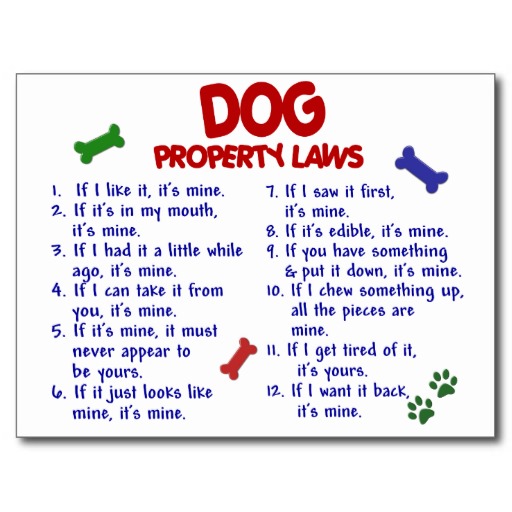 Next, learn your dog’s body language and what it means. Your dog gives off all kinds of signals long before the growl to let you know he is uncomfortable. Have a look at the infographics page for handouts on canine body language http://barking.ie/infographics/
The next step is to teach the dog its a good thing to have you near when he is eating or has a prized bone by throwing tasty tidbits towards him as you walk past (again, we are leaving the food he already has in his bowl and not even looking at his bone). We keep doing this until they are happy and comfortable to have us standing near them.
After that, we teach the dog that its a good thing to give us items they love, and they get them right back! Teaching a solid ‘Drop’ cue will help, but don’t attempt this with items the dog guards to start with. Start with toys that the dog will happily exchange for a bit of chicken and work your way up to the things he loves.
To avail yourself of a step-by-step, easy to follow workbook, get in touch. You can get the plan via email for €25.00, including support by telephone and email, or you can book a one-on-one consultation to have me come to assess your dog and demonstrate the method in person!

Jumping up on Strangers
Whether its visitors to our house, or random people when out on a walk, some dogs can’t seem to help themselves and jump up all over people.
The reasons are usually one of two…
1. Your dog loves people. He likes to meet and greet them and smell them and ask them for pets, hug them and kiss them and call them George. The jumping will be preceded by wiggly body language and possibly excited vocalization.
2. Your dog wants people to go away and leave him alone and he is literally pushing them away. This may be preceded by carrying his body lower, tucking his tail and/or holding his ears back. See the Dog Decoder app if you need help learning about canine body language.
Lets deal with the second one first, as, although a more complex emotional motivation, and not as common as the first, it can be easier to manage, but take longer to treat. Your dog is trying to protect himself, so if you take on that role and step between the dog an any approaching person, he will not need to push them away.
If your dog is scared of people and just wants them to go away, do not allow strangers to approach him. You may want to invest in a Space Dogs vest (insert link). Keep him on lead and make it clear that he does not want to be approached.
Be vocal in your defense of your dog. Don’t fall for the “but all dogs love me” line… let them know in no uncertain terms that you are working on training and that they are not to approach your dog. The more comfortable he becomes that people are not going to invade his space uninvited, the less he will feel the need to drive them away.
Teach your dog the “behind” cue: set up a slalom course (I use full 2 liter water bottles for this). Walk through the course with your dog on lead. When you get to a bottle, step slightly in front of your dog so that he has to wait to follow or run over the water bottle, as he side-steps to get behind you, mark it with your cue word (say ‘behind’) and give him a treat. Alternatively, lure your dog with a food treat in your hand to step behind you, add your cue and give the treat when he gets into the correct position. This will allow you to cue your dog to hide behind you, giving a barrier between the stranger and the dog.
Counter-condition: change the way your dog feels about people by embarking on a course of counter-conditioning where his favorite things appear within a second or so of an approaching stranger.
Now, back to the excitement jumping. I would always recommend starting with impulse control exercises like Its Your Choice. Whilst this speeds and aids the training of “Don’t jump on people” its not 100% required.
Really, all you need to do is a) prevent…keep your dog on lead and ask people approaching to wait for the dog to sit or lie down before they are allowed to pet or greet your dog. If necessary, stand on the excess lead (allow enough room for your dog to stand, sit and lie comfortably, but not enough room to jump. If the dog cannot settle, simply turn and walk away. He has lost his opportunity to greet this person. AND b) any approach towards a person that keeps 4 paws on the floor and a reasonable sense of decorum should be rewarded both with food (dropped on the ground or delivered low under the muzzle during the approach to keep the head focussed down) and with attention (once they have reached the person). Even if you have to drop food every 1/2 second while approaching someone, continue to do so until the dog learns that rude greetings = no greeting and polite greeting = food + attention.
In the home, put up baby gates or other barriers to prevent jumping, treat as above both for fear and impolite but excitable greetings. Keep the dog out of the way until he can contain himself enough to greet politely, or completely out of the way (with a nice filled kong) if he is fearful of the visitors.
Further help is available with one-to-one in home consultations.
You wash your dog weekly, you vacuum daily and mop at least a couple of times a week, but you can’t seem to get rid of that pervasive doggie odor in your house.
Well, suck it up, you’re the proud companion to a smelly beast!
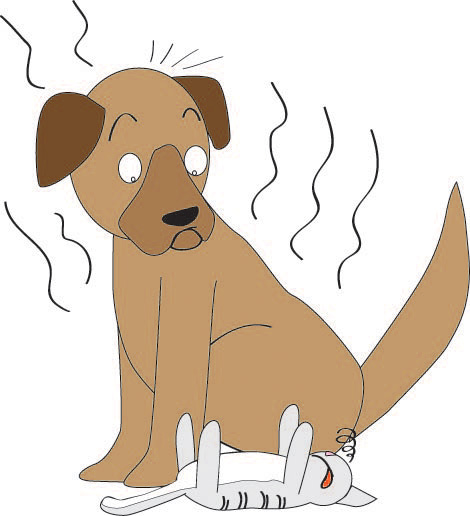
Actually, there are a few ways you can minimize the odor without banning your furbeast to the garden.

We all talk about training behaviours into or out of our dogs. We talk about teaching the dog to come when called, or not to jump up to greet. Once these behaviours have been taught to the point where the dog performs them (or doesn’t as the case may be), owners tend to stop reinforcing the correct response.
We spend time, money, and calories to teach our dog what to do. We purchase training aids, treats, toys, special leads and harnesses, sometimes treat pouches, ball chuckers and more. We teach the dog to sit when asked, come back when called, walk nicely on the lead. Then months later, the dog seems to ‘forget’ everything we taught him in those weeks of intensive training. Some might say the dog is ‘stubborn’ or that he is trying to ‘be dominant’ or stage some sort of household coup. Some might say the dog is ‘acting out’ from spite or boredom. However, it usually is just down to nothing happening.
We might offer the occasional ‘good dog’ or a scratch behind the ears when we have asked for a sit, and clearly if we use punishment to eliminate unwanted behaviour, there is no need to punish what doesn’t happen. But long-term, how do we ensure that those taught behaviours keep happening and prevent the unwanted ones from coming back?
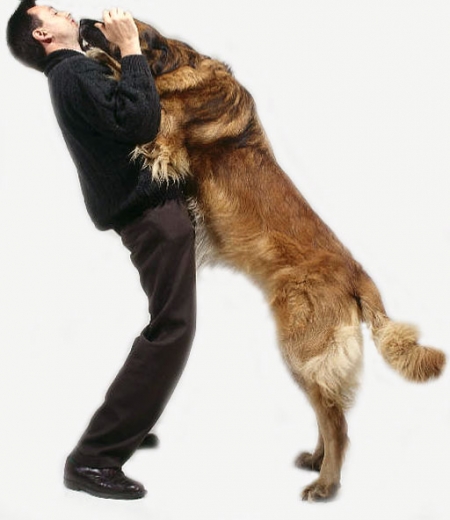
Because, you see, when nothing happens, the dog decides whether the action (or lack of action) is reinforcing enough to do it again and again and again without any external reward. Sitting calmly at the front door instead of mauling you when you bring in the groceries might not press his buttons when you blow past him for the 50th time without so much as a glance or a word of praise. Coming back when called might not be very enticing when every single time you call you put him back on the lead to end the walk.
Over time, when ‘nothing happens’, something happens. The dog starts choosing behaviours and scenarios that are more reinforcing for him. Blowing off recall to say ‘hi’ to an interesting person or chase leaves, jumping on you when you come in from work to get your attention instead of sitting quietly waiting for a greeting that doesn’t happen (or doesn’t happen fast enough); pulling on the lead to get to another dog instead of walking nicely with you until you reach it and give him the go-ahead.
So, what’s the solution? Feed your dog every single time he does something we have taught? Yell or knee the dog in the chest when he starts jumping up again? NO. All you need to do is occasionally and randomly reinforce the behaviours you like with real rewards. Food, play, attention. When you come home from work and your hands aren’t full of groceries, stop and scratch behind his ears when he is sitting to greet! Call him back on your walk just for a biscuit and then release him to go back to doing doggie things (yes, the release is part of the reward!). Hand him a couple of bits of food out of his bowl when you have asked him to sit and wait for his meal. If you reward your dog at least 1 out of every 10 times he performs the things you like (whether you have asked for them or not), he will continue to repeat them and stop looking for other things that will work better.
Need help getting there? Contact us today! Ring 0872649510 or complete the form below.
If I tell someone that I work with dogs, it’s guaranteed that that person will ask me for advice about their dogs. This happens no matter where I am.
If I’m getting a massage, I get asked about house training problems. If I’m at the dentist, my hygienist wants to know how she can convince her mother not to be terrified of her pit bull (who is lovely, thank you very much). And when I’m at the gynecologist, my doctor is asking me about her elderly dog’s end of life issues.
Let me say this from years of experience with a variety of gynecologists who have nothing in common with one another except that they all like to talk to me about their dogs while they root around in my lady bits:
So there I was at my new doctor’s office…
View original post 1,095 more words
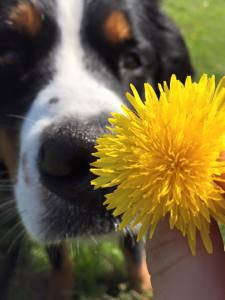 I thought the word trust would be one of those vague labels that is tough to pin down. You know, hard to define but you know it when you see it. But when I checked the dictionary, I was intrigued to find two simple ideas that hit the nail on the head. Under the word trust it said,“the confident expectation of something” and “implies a feeling of security.” – Susan G. Friedman, Ph.D.
Earlier this week, I took a fearful training client of mine to the beach. The fact that joyful trips to the beach are now a regular occurrence for her is a beautiful one because one year ago, these trips were not possible. Despite excellent socialization and dedicated dog parents, this dog entered a severe fear period, developing several phobias and generalizing her fear to previously safe environments, one of those being the beach. Through dedicated work desensitizing and…
View original post 760 more words
More on ‘don’t punish the growl’.
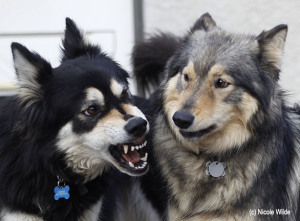 A woman I sometimes chat with during my morning dog outings asked my opinion about an encounter she recently had. She’d been been walking her four-year-old mixed breed dog around a local park when she crossed paths with a man whose dog was off leash. As the owners walked toward each other on the narrow trail, the foot loose and fancy-free puppy ran up to the adult dog. With the usual lack of canine cluelessness that accompanies early dogdom, the pup leaped at the dog relentlessly in an attempt to initiate play. The woman’s dog, while not aggressive, did not want to be bothered. He growled. The puppy didn’t back off, and again tried to engage the older dog. The dog growled louder. The man made no attempt to put his dog on leash. The woman, feeling embarrassed that her dog had growled, ended up apologizing to the man and…
View original post 561 more words
Because dogs don’t speak our language, the only way to truly comprehend and communicate with them is for us to understand and appreciate what they are telling us through their body and vocal […]


 Barking Up the Right Tree